Returning to Norway, we encounter a band not as widely known as the elite of the second wave, but one that formed before many of them: OBTAINED ENSLAVEMENT. Formed in 1989 in Stord, they started out as a three-piece. The founding members initially went by their legal names before adopting evil stage names: Thomas ("Pest"), Orjan ("Torquemada"), and Ove ("Døden").
They toiled in the underground as a three-piece for a few years before Heks joined as second guitarist and keyboardist in 1992. It was then that they started putting out demos. After their self-titled demo in '92, it was 1993's Out of the Crypts that caught the ear of metalheads worldwide.
In its entirety, here is the Out of the Crypts demo
On their early nineties demos, OE was--like many Norwegian bands at the time--a raw old-school death metal band. Black metal was still in its infancy in Norway, with a mere smattering of second wave albums having been released.
Obtained Enslavement's sound, however, began to evolve. By the time of the release of their self-funded debut album--1994's Centuries of Sorrow--they had begun to take on a more blackened sound. The drum production still sounds pretty death metal to me, but otherwise, it's an aggressive black metal style. Listen below:
From their debut, here is "Dark Holiness"
Despite being basically self-released, Centuries of Sorrow caught the attention of the black metal underground. It didn't sound like the then-typical Norwegian sound. But change was in the air.
The follow-up was the brilliant Witchcraft, which took three years to release because of issues finding a reliable record label. The aggressive style of Centuries was gone in favor of a more traditional Norwegian black metal riffing. At the same time, Heks's synth playing--with the help of folk and classical instruments--added a grander, more epic feel to the songs. It's an incredible album that belongs in heavy rotation for any fan of melodic and symphonic black metal.
"From Times in Kingdoms..." is from Witchcraft
1998's Soulblight continued the sound of Witchcraft. It was a solid release of symphonic black metal that built on its predecessor. Highlighted by ice-cold riffing, Soulblight is a sorely overlooked classic of Norwegian black metal.
Soulblight gives us "The Dark Night of Souls"
These years were busy times for the members of Obtained Enslavement. In addition to releasing incredible black metal albums, their skills were in high demand elsewhere. Pest, for example, was briefly the vocalist for Gorgoroth--but OE was his main focus.
In 2000, OE released The Shepherd and the Hounds of Hell. An underwhelming release, it sounded more like typical black metal, and had a crisper, cleaner production style. It was not a bad album, but it alienated many fans. Around the time of the release of this album, Pest relocated to the USA. Shortly thereafter, the band broke up.
Select Discography:
Obtained Enslavement (demo) (1992)
Out of the Crypts (demo) (1993)
Centuries of Sorrow (full-length) (1994)
Witchcraft (full-length) (1997)
Soulblight (full-length) (1998)
The Shepherd and the Hounds of Hell (full-length) (2000)
In the Czech black metal scene, the names of A-list bands like Master's Hammer, Root, and Maniac Butcher ring out. But just below them are bands like AVENGER. Hailing from the South Bohemian Region, they formed in 1992 as Astaroth before changing their name in 1993.
Announcing themselves to the world with demos like 1994's Minister of Madness, they began life as an old-school death metal band. Their sound was unremarkable in this regard, but the best was yet to come.
Here is Minister of Madness in its entirety
They struggled getting off the ground because of their early line-up instability, but after some label interest, were able to put out their debut full-length album, 1997's Shadows of the Damned. Their sound was still fundamentally an old-school death metal style, but with some black metal elements mixed in (I maintain that some of the riffing in some of the songs would sound more like black metal with slightly different drumming laid underneath).
"Kořeny zla" comes from Shadows of the Damned
Their follow-up album was 1999's Fall of Devotion, Wrath and Blasphemy. The band was initially not happy with the album's sound, so they re-recorded it in 2001 at Hellsound, a studio owned and operated by band co-founder and primary song writer Honza Kapák. Whichever version you listen to, the change in sound from their first album is apparent. It's still a (mostly) death metal foundation, but with some black metal riffs and drumming. Sound-wise, it's as if old-school Swedish death and black metal collaborated.
From their second full-length album, this is "V Okovech"
As the years passed, Avenger's sound began to incorporate more and more black metal elements. They've become known in metal circles for their blackened death metal style, but they call themselves "Bohemian dark metal" (even going so far as to release an album with that title in 2012). After the release of a sixth album in 2017, they disbanded--only to reform as a new band, Bohemyst.
From 2003's Godless, here is "Execution of the Soul"
Bohemian Dark Metal gives us "Fales a apatie"
Select Discography:
Pandemonium (demo) (1993)
Eternal Voices of Hell (demo) (1993)
Minister of Madness (demo) (1994)
The Black Zone (demo) (1995)
Shadows of the Damned (full-length) (1997)
Fall of Devotion, Wrath and Blasphemy (full-length) (1999/2001)
Godless (...Assuming the Throne of Immortality...) (full-length) (2003)
Feast of Anger, Joy of Despair (full-length) (2009)
Bohemian Dark Metal (full-length) (2012)
Next time: FRANCE'S LES LÉGIONS NOIRES - VLAD TEPES
Austrian extreme metal isn't the most well-known the world over, but there are a handful of bands who've made a massive impact. BELPHEGOR is definitely one such band. In their own words, they play "metal of death" with "blasting black metal influences."
Arising from the ashes of old-school death metal band Betrayer, Belphegor was formed in 1992 by Helmuth, Chris, and Max. Their goal, like many such extreme bands, was to make extremely brutal music that was "raw, primitive, and obscene." Inspired by such bands as Death, Deicide, Mayhem, Slayer, and Mötorhead, they have definitely succeeded in their stated goal!
This is their complete 1993 demo, Bloodbath in Paradise
They released a brutal, take-no-prisoners demo in 1993, Bloodbath in Paradise. The music on this demo was a vicious, angry death metal--not really black metal at all. But Belphegor were just getting started!
After the 1994 EP Obscure and Deep, they entered the studio and recorded their first full-length album, The Last Supper. A continuation of their early sound, this album combined the raw death metal they had already been playing with atmospheric synths and black metal tempos for a black/death sound unlike any other.
"A Funeral Without a Cry" comes from their first full-length album
Off of 1997's Blutsabbath, here is "Purity through Fire"
Belphegor's third full-length, Necrodaemon Terrorsathan, showed a shift in sound. On this release, the death metal receded a bit in favor of black metal-influenced song structures. Brutal death metal riffs (reminiscent of Morbid Angel, to my ears) gave way to blazing fast passages that would not feel out of place in a Swedish black metal album. Check out "Vomit Upon the Cross," below:
Belphegor is definitely a band that marches to the beat of their own drum. When they formed, American death metal was peaking and second wave Norwegian black metal was on the rise. Yet, they chose not to follow either path, but carve their own. Even their lyrical inspiration--everything from the poetry and prose of Marquis de Sade to occultic writings of Aleister Crowley to the texts of ancient rituals--doesn't always neatly fit into the trendy extreme metal topics of the day.
In the early 2000s, Belphegor continued to plug away as an underground extreme metal band. Besides two incredible albums of vile black/death (Lucifer Incestus and Goatreich Fleshcult), they also put out a live album on their own record label. But it was in 2006 that saw things really shift for the band.
"Hell's Ambassador" is the most well-known song from '06's Pestapokalypse VI
First off, their latest album--2006's Pestapokalypse VI--was getting rave reviews. The mainstream metal media was finally giving Belphegor the kudos they deserved. Second, this was also the time when Belphegor had slimmed down to a two-piece: Helmuth and Serpenth were now the core of the band. Add this to the fact that they were finally on a record label that could properly support them (Nuclear Blast), and we'd entered a new phase for these Austrian metal maniacs.
2008's Bondage Goat Zombie gives us "Stigma Diabolicum"
The focus for the band since then has been staying true to their musical vision, all while relentlessly touring. They think of their performances as "rituals"--not shows. In 2010, while on tour, Helmuth was exposed to contaminated water and contracted typhus. The experience nearly killed him. But after a long recovery, Helmuth emerged as dedicated as ever to Belphegor. And the band keeps soldiering on.
"Rex Tremendae Majestis" is from 2014's Conjuring the Dead
I noted earlier that there is no such thing as one, single Italian black metal style. And I stand by that statement. Mortuary Drape, Sinoath, Schizo, Winged, Opera IX...they sound nothing alike. Even bands that are part of the same subgenre (Necrodeath and Bulldozer are both black/thrash by modern standards) have unique styles. Rome's STORMLORD is further evidence of this.
Formed in 1991, Stormlord initially began as a death metal project. Their first demo in 1992 bears this out. After recruiting a second guitarist, they released a second demo in 1993, Black Knight. Due to the use of well- placed synths, this demo had a more epic, grand feel to it. This epic aura would continue on future releases.
This is the Black Knight demo in its entirety
After these two demos, the band began to get tired of the direction death metal was going in. Additionally, they weren't happy with the sound of their death metal growls. They then began crafting epic songs that leaned more in the direction of black metal. Around this time, record labels began expressing an interest in the band, too. After crafting a promo of material for record labels and then an MCD of new material in 1997, the band released their first full-length studio album in 1999.
This is "War (The Supreme Art)"
Titled The Supreme Art of War, this album saw a mix of symphonic black metal, epic power metal, and some folk elements as well. By the band's own admission, the sound on Art of War was a result of a more democratic approach to song writing and their new keyboard player being classically trained. The epic synth passages gave the entire album an almost medieval, folk vibe.
"...And Winter Was" is off of their 2001 album, At the Gates of Utopia
Exploding out of the underground and into the black metal mainstream at a time when symphonic black metal was peaking, Stormlord resisted that label themselves. Noting that they thought of bands like Immortal and Darkthrone as black metal, while bands that incorporated synths the way they and Dimmu Borgir did were something different, they labeled themselves "epic extreme metal."
"Dance with Hecate" comes from their 2004 album, The Gorgon Cult
I would argue that the label they came up with for themselves makes sense the more you listen to their later albums. Beyond the elements of symphonic black metal, you have a wide variety of clean vocals, operatic vocals, riffing that is reminiscent of power and death metal, and exotic folk elements. Fans of viking metal, folk black metal, and symphonic black metal would enjoy what Stormlord has to offer, but they're really so much more than that.
From 2008's Mare Nostrum, this is "And the Wind Shall Scream My Name"
Like Crucifier, GRAVEWÜRM is one of those American bands that toiled away in the underground with demo after demo before releasing actual studio albums. Hailing from near Pittsburgh, Pennsylvania, before relocating to Northern Virginia (where I live!) and then Ohio, Gravewürm plays a raw, angry black metal not for the faint of heart.
Originally formed as Dominion in 1990, they started off as more of a doom-death band. But as the main force behind the band, Funeral Grave (born one Kevin Fye), became more interested in bands like Goatlord, Beherit, Burzum, and Emperor, it became necessary to change the face of Dominion completely. And so by 1992, Gravewürm had emerged.
1993's Possessed by Darkness is an early demo
By their own admission, their sound draws on first-wave black metal bands and classic heavy metal. There are no blastbeats, and the song structures are very straightforward. The influence of old-school bands like Venom, Sodom, and Hellhammer is apparent as well.
This is the title track to their '96 demo
According to the band themselves, it was a challenge to get record labels interested in putting out a full-length studio album. Their sound didn't match any of the black metal trends of the day (clones of the Norwegian styles of Darkthrone or Mayhem, or symphonic black metal), so label after label passed on them in the late 1990s. That didn't stop them from releasing vicious underground demos!
This is a live performance of "Ancient Storms of War", the title track from their first official studio album
Once labels expressed interest, Gravewürm simply has not stopped releasing album after album of nasty, vile old-school black metal. 2000's Ancient Storms of War was their first official studio album (see above for the title track), and since that time, they've released over twenty albums.
"Under the Banner of War" comes from the 2005 album of the same name
Gravewürm has also admitted that they're not afraid to mix it up a little bit. Sometimes an album will draw heavily on old-school black/thrash, sometimes it will draw on doom metal, and so on. At the end of the day, you know you're getting raw, brutal black metal that is true to the old-school ethos!
Off of 2010's Blood of the Pentagram, this is "Goat Command"
"Lair of the Gravewurm" is from 2015's Doomed to Eternity
Stockholm, Sweden's NECROPHOBIC represents an interesting conundrum in extreme metal.Having formed in 1989, they set as their goal the creation of a darker, more sinister style of death metal than existed at the time. Yet, they cited old-school black metal like Bathory as their primary influences. Furthermore, I see them on black metal playlists all the time, but they sound more death metal to me. Their guitar tone is more Sunlight Studios than Grieghallen to my ears.
This raises one of the most interesting aspects of heavy metal: the separation of bands into different genres. While some metalheads lament the drawing of lines that determine which band is or is not one particular genre or other, others go the opposite direction. I find myself in the latter category: genre distinctions are important to me. To those on the other side of this discussion, I ask you this: you're gonna tell me that Mütiilation sounds like Iron Maiden? Or that a fan of Deeds of Flesh would love The Gathering? Distinctions are important.
So what happens when the distinctions literally collapse? When you don't know where to put the line? This post is going to explore that question.
Celtic Frost: death metal? Black metal?
The line between death and black metal was originally fairly arbitrary. This is why some bands from the early days belong to both traditions: think Hellhammer/Celtic Frost. But why is Possessed associated with death metal more than black metal when they sound like a lot of bands that are labeled "black metal" from the same era (Necrodeath, Sarcofago)?
Now, the lines are clearer. No one would point to Darkthrone's Transilvanian Hunger and call it death metal. Similarly, no one would call the latest Dying Fetus record black metal. But there have been bands that are hard to classify, and they weren't even trying to blur any lines. They were just making the music they wanted to make.
Returning to Necrophobic, what are we to make of them? Where do they fall? Their current label, Century Media, even calls them blackened death metal. Have a listen to a few songs, below:
"Before the Dawn" is from Necrophobic's 1993 debut album
"Spawned by Evil" is off of 1997's Darkside
2002's Bloodhymns is the source of "Cult of Blood"
We see why it's so tough to figure out. A few adjustments one way and you've got a Dissection b-side. A few adjustments the other way and it resembles a classic Unleashed or Dismember song.
Two other Swedish bands--GROTESQUE and UNANIMATED--also merit being part of this discussion. Where do they fall? Grotesque eventually evolved into At the Gates, the most famous melodic death metal band of all time. But there are those that call them black metal. Unanimated suffers from the same fate. Take a listen:
Grotesque's "Angels Blood" is from 1989/90
"Blackness of a Fallen Star" comes from Unanimated's 1993 album
We've got songs with blazing fast tremolo-picked riffs, but with a death metal guitar tone. We've got blasphemous lyrics. The overall song structures wouldn't be out of place on a melodic death metal or melodic black metal album. What do we call songs by bands such as these? Of course, an acknowledgement of this issue recognizes that some of the bands I've already explored could be questioned as well: is Dissection really black metal? Sacramentum?
From the opposite direction, the American band ACHERON enters the debate. Emerging as part of the Tampa, Florida, scene in the late 1980s, they are typically thought of as a death metal band. Yet, their blasphemous themes and dark aura feel almost blackened. Listen below, to "To Thee We Confess," off of their first full-length album:
Again, why stop there? What about Crucifier? Order from Chaos? At the end of the day, it's about drawing a line and sticking with it. On this side, we might find Dissection, but on the other side, we might see Necrophobic. Or perhaps not?
Select Discography:
Necrophobic:
Realm of Terror (demo) (1989)
Slow Asphyxiation (demo) (1990)
Unholy Prophecies (demo) (1991)
The Call EP (1992)
The Nocturnal Silence (full-length) (1993)
Spawned by Evil EP (1996)
Darkside (full-length) (1997)
The Third Antichrist (full-length) (1999)
Bloodhymns (full-length) (2002)
Grotesque:
Ripped from the Cross (demo) (1988)
The Black Gate is Closed (demo) (1989)
In the Embrace of Evil (demo) (1989)
Rehearsal (demo) (1989)
Incantation EP (1990)
In the Embrace of Evil (compilation) (1996)
Unanimated:
Rehearsal (demo) (1990)
Fire Storm (demo) (1991)
In the Forest of the Dreaming Dead (full-length) (1993)
Norwegian band IN THE WOODS... represents a unique chapter in the history of black metal. Their style in the late nineties was like almost no one else in the Norwegian scene, and they have unique connections to other crucial black metal bands at the same time.
ITW formed from the ashes of death metal band Green Carnation in 1991 when band member Tchort went to join Emperor on bass. Green Carnation dissolved and remaining members Anders, Christian, and Christopher formed ITW--recruiting Oddvar and Jan along the way--as an outlet for their nascent black metal sound. Their first demo in 1993 was a raw piece of black metal that didn't do too much to stand out from the pack.
Here is the '93 demo in full
Shortly after the release of that demo, ITW entered the studio with the goal of releasing a second demo. This demo--1994's Isle of Men--was essentially the first demo re-recorded. The sound quality was improved, but this was still the same music: a somewhat raw, midpaced black metal.
This is the 1994 version of "Tell de døde", from the Isle of Men demo
The Isle of Men demo in 1994 proved to be a pretty well-received demo in the black metal underground. It has been reissued by several different record labels as a CD, most recently by Soulseller Records. It is pretty easy to find these days, if you're interested in acquiring a copy.
That said, ITW began pushing the boundaries of their music after the release of Isle of Men. The midpaced black metal sound on their demos eventually gave way to a melodic and progressive folk-influenced style on their first full-length album, 1995's Heart of the Ages. With a sound that reminds the listener of Isengard and older Arcturus, all wrapped up in an atmospheric package, there really was nothing like it in the Norwegian scene at the time of its release.
"...in the woods" is probably the most traditionally black metal song off of Heart of the Ages
Now calling their music 'pagan metal'--despite not having all of the hallmarks of that genre--ITW had really made their mark on the Norwegian scene, and by extension, global black metal. If they had called it a day after releasing this album, they'd still be a noteworthy chapter in the history of black metal. But in this first phase of their existence (they broke up in 2000), they put out two more albums that revolutionized extreme metal.
On 1997's Omnio, they moved away from black metal, but kept a dark, moody aura to their music. With epic, progressive passages painted over a doom-y riffing style, Omnio is a hard album to characterize. Not really like any kind of traditional black metal, fans of modern-day atmospheric and epic black metal like Saor, Aquilus, or Agalloch might find themselves at home on this album.
From 1997's Omnio, this is "Weeping Willow"
On 1999's Strange in Stereo, they moved even further away from traditional black metal. Still possessing the dark, moody atmosphere from Omnio, their music reminds the listener of old-school gothic rock bands like Bauhaus at times. Strange in Stereo is an odd album--one whose name is very apt. This is an album that further alienated hardcore black metal fans, but brought in a whole new audience of open-minded listeners.
"Closing In" is the opening track from Strange in Stereo
But all was not well in the world of ITW. The band members could not agree on the direction to take the band, and these musical differences would prove fatal to the band. In the Woods... broke up in the year 2000 (In the Woods...did get back together in the 2010s, but their music was more in the doom-death vein than it was black metal). But as fortune would have it, some of the band members had recently reconciled with Tchort, and Green Carnation was re-formed as a result. If you listen to the Green Carnation albums from the early 2000s, you can hear some similarities with what ITW was doing on Omnio and Strange. Check out "Light of Day, Day of Darkness," below, to see what I mean.
MORBOSIDAD, who formed in Oakland, California, despite the band members being from Mexico, is a raw and brutal band known for a style that blends elements of war metal and black/thrash. There has been some debate about when they formed, with the band insisting they didn't form until 1993, but Tomas Stench (the mastermind behind the band and the one constant in the band) realizing they had actually formed in 1991 after finding an old interview in a 'zine from that year!
Regardless, it wasn't until '93 that their first demo was released. Their follow up, 1994's Santísima Muerte, was what made the extreme metal underground sit up and take notice. Featuring a sound that was heavy on the death metal side, Morbosidad's lyrics were also noteworthy for being highly blasphemous, in the vein of Profanatica.
Here is the complete 1994 demo
Just as things were starting to take off, tragedy struck. Their drummer died in a freak explosion in 1995. The band was devastated, and put things on hold. They didn't return to making music until 1999.
When they returned on the scene with new material in 2000--including their self-titled full-length album--their sound was still primitive and raw and evil. However, they were less death metal and more like what we now know as war metal.
From their self-titled album, this is "Bestial y Morboso"
Morbosidad is nothing else if not consistent. They wear their influences--Sarcofago, Beherit, Blasphemy, Archgoat--on their sleeve. Each release features that insane war metal style, with ultra-blasphemous lyrics in Spanish (because, according to Tomas Stench, "it gives our music a more primitive, evil, and blasphemous sound"). Even among American war metallers, very few bands sound like Morbosidad.
From their 2004 album, this is "Sangriento Sacrificio Cristiano"
Since their re-emergence in 1999, Morbosidad has consistently released brutal black/death brilliance on album after album. Even when drummer Goat Destroyer fell out of a window and died in 2009, the band soldiered on. In fact, they actually put out albums in his honor, including a split with Manticore.
"Poseido por el Diablo" comes from 2008's Profana la cruz del Nazareno
Select Discography:
Demo '93 (demo) (1993)
Santísima Muerte (demo) (1994)
Morbosidad (full-length album) (2000)
Bajo el egendro del crucificado EP (2002)
Cójete a Dios por el culo (full-length album) (2004)
Legiones bestiales EP (2006)
Profana la cruz del nazareno (full-length album) (2008)
Members of Mayhem and Darkthrone in an early '90s photo
DARKTHRONE'S release of A Blaze in the Northern Sky in 1992 was an earth-shattering event in the history of black metal. The Norwegian scene hadn't put out many full-length studio albums yet, and Darkthrone's first album was basically death metal, not black metal. Darkthrone now consisted of three members since Dag Nilsen had left: Zephyrous, Nocturno Culto, and Fenriz. However, they had a renewed focus now that they were committed to black metal.
The follow-up to Blaze is the 1993 classic Under a Funeral Moon. On this album, Darkthrone (by their own admission) moved even further away from their death metal roots. They acknowledged that they had still used a death metal template for some of their songs on Blaze, but had now jettisoned that foundation. Even Fenriz himself admitted that Blaze was "a lot of death metal with some black metal parts." 1993's Under a Funeral Moon, however, was "pure black metal."
Here's "Unholy Black Metal," from Under a Funeral Moon
With Under a Funeral Moon (even more than Blaze), the classic second wave black metal template began to solidify. The primitive, blasting drums; the raw, screeched vocals; the tremolo picking riffs....all of it was present in a way that felt new and fresh. It has even been called the "blackest black metal" album that Darkthrone has ever made.
Soon after its release, Darkthrone entered the studio to record its follow-up. At the time, however, things had changed in the Norwegian scene. In 1991 and 1992, things in the Norwegian black metal scene had been relatively organic and tightly knit. There were few actual black metal bands and the focus was on the music. But by 1993, the church burnings and murders associated with the Inner Circle had begun to distract people from the music. It also attracted media attention and resulted in the scene being flooded with black metal posers. This state of affairs greatly influenced Darkthrone's mindset as they recorded their next album.
"Slottet I Det Fjerne" is one of their most famous tracks from Transilvanian Hunger
Now a duo (Zephyrous left the band after a car accident), Darkthrone released album number four in early 1994. This album--Transilvanian Hunger--was another masterpiece that changed the face of black metal. Even more raw, with an aura of misanthropic darkness (which resulted from a dark, ultra lo-fi production), Hunger had blazingly fast songs that influenced a generation of black metallers. Within the span of three years, Darkthrone had revolutionized black metal.
One source of controversy was the band's messaging on the album itself. On the back cover of the album, the band labeled their music as "Norwegian Aryan Black Metal," and in the liner notes they noted that anyone who criticized their music was behaving in a "Jewish" fashion. Years later, Fenriz himself noted that this kind of language was unacceptable and even called it "disgusting."
Off of Panzerfaust, this is "Hans siste vinter"
While Darkthrone's first three black metal albums (Blaze, Funeral, Hunger) are sometimes called their 'unholy trinity' because of how influential and revolutionary they were, I like to lump in their 1995 release, Panzerfaust, as well. The structure laid down on Hunger and Funeral were present, to some degree, but the production values were notably different. The vocals had a more vile, trebly feel to them than in previous albums, giving the entire album an angry rawness that was less present on the earlier releases. All told, Panzerfaust is just as essential as Under a Funeral Moon or Transilvanian Hunger.
Poland is a country with an absolutely incredible black metal scene. While I have already talked about the titans of classic Polish black metal--Graveland and Behemoth--I'd like to talk about some noteworthy mid-tier level bands of the early second wave. Let's start with ABUSIVENESS, from the city of Lublin.
Founded in 1991, Abusiveness emerged at the time when Soviet bloc countries were transitioning to Western-style democracies. In places like Poland, this saw a flourishing of previously-banned ideologies, like pre-Christian paganism. Abusiveness embraced paganism with a passion, and those once-outlawed ideologies become their raison d'etre.
Despite forming in '91, Abusiveness's first sonic assault on the world didn't emerge until 1994. The demo Parentalia was a lo-fi slab of black metal with a heavy dose of synth for atmosphere. Listen below:
Here is the complete Parentalia demo
The '90s saw Abusiveness remain a mostly underground phenomenon, with a slew of demos and a split with fellow countrymen Hefeystos (see below). By the early 2000s, though, they had signed with major labels and begun releasing studio albums proper.
From Krzyk świtu, this is "Mogila"
On albums like 2002's Krzyk świtu and 2007's Hybris, Abusiveness played a style of black metal that was the perfect mix of raw, in-your-face evil, and majestic synths, with lyrics praising their Slavic heritage. In the Polish scene, there are few that sound like them.
"Fame of Arkona" comes from the album Hybris
Select Discography:
Parentalia (demo) (1994)
Visibilium Invisibilium (demo) (1996)
Dwie twarze mroku (demo) (1997) Watrajar (split with Hefeystos) (2000)
HEFEYSTOS--already mentioned in connection with their split album with Abusiveness--isan important band in the Polish scene, despite their limited output. Formed in 1994, Hefeystos became known relatively quickly for their gothic-tinged symphonic black metal. After a self-titled demo, they went on to release a self-titled album in 1996.
"Magiczny strumień" comes from their 1996 album
Their self-titled album was a moody gothic black metal masterpiece. Comparable to Moonspell, Opera IX, or perhaps even early Cradle of Filth's more synth-heavy moments, 1996's Hefeystos was a testament to the true beauty in darkness.
After this release, Hefeystos's second full-length album was a little too experimental for most black metal fans. But they still remain a crucial band in the history of second-wave Polish black metal.
MASTIPHAL, from Katowice, is kind of the flip side of the coin that is Hefeystos. Where Hefeystos used synths to achieve a mystical, gothic atmosphere, and the guitar playing complemented it, Mastiphal went in the opposite direction. Their angry, evil guitars set the tone for their music, and instrumental, synth-heavy passages merely hinted at a folksy mood.
From their major '90s album, this is "Flames of Fire Full of Hatred"
After going on hiatus for over a decade, Mastiphal returned with a vengeance in the late '00s as blasphemous as ever. I especially recommend their song "Rituals" from the great compilation of Polish black metal Silesian Black Attack, below:
Select Discography:
Sowing Profane Seed (demo) (1994)
For a Glory of All Evil Spirits, Rise for Victory (full-length album) (1995)
Perhaps my favorite mid-level Polish band from this time period is NORTH. Hailing from Toruń, North formed in 1992. Their raw, stripped-down version of pagan black metal has been compared to some of Norway's best and brightest (or darkest?).
This is the title track from their first demo
What I love about North is their unique guitar tone. I can think of few mainstream black metal bands that have such a vile tone. I like to think of it as the black metal equivalent of the buzzsaw Swedish/Sunlight Studios sound, with a hint of Darkthrone's Transilvanian Hunger. Listen below:
"The Heretic Kingdom" is from North's first full-length
Select Discography:
Entering the Dark Kingdom (demo) (1993)
As my Kingdom Rises (demo) (1993)
Promo reh. '94 (demo) (1994)
Thorns on the Black Rose (full-length album) (1995)
Jesienne szepty (split with Sacrilegium) (1996)
Sovereigns of Northernlands (split with Grom and Marhoth) (1996)
Other bands from the early second wave of Polish black metal worth a mention are GROM, SACRILEGIUM, THEMGOROTH, and SAURON. They all made their mark on Polish black metal, but never quite achieved legendary status.
Select Discography:
(in alphabetical order)
GROM, Na granicy dwoch swiatow (demo) (1995)
SACRILEGIUM, Sleeptime (demo) (1994)
---, Wicher (full-length album) (1996)
---, Recidivus (demo) (1998)
---, Embrace the Darkness (demo) (1999)
SAURON, Hellish Requiem (demo) (1993)
---, The Baltic Fog (demo) (1995)
THEMGOROTH, Demo '94 (1994)
---, Gate to the Unknown... (full-length album) (1995)
---, Highway into the Unknown (full-length album) (1998)
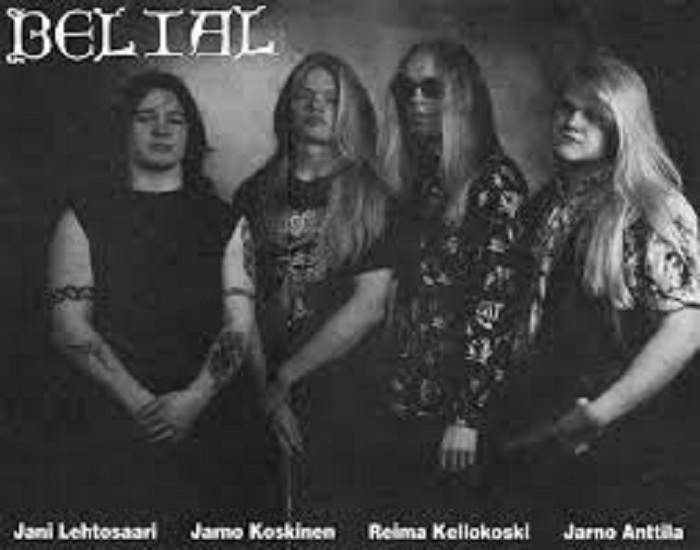
Part of that brutal scene of early nineties Finnish black and death metal, BELIAL is one of those bands that doesn't get the respect they deserve. From the city of Oulu, Belial's members never really went by evil stage names. Perhaps this was because of their close connection to fellow Finns Impaled Nazarene, all of whose members went by their regular names. In fact, when Belial did eventually break up, some of their members went on to play in Impaled Nazarene.
Forming in early 1991, it was their first demos--especially Gods of the Pit, released in October of that year--that really made them known in the extreme metal underground. Limited to 500 copies, this cassette-only demo featured a raw and brutal black/death style that compares favorably to fellow countrymen Archgoat. In terms of genre, even the members of Belial themselves have acknowledged that it was "basic death metal...with a flirtation in the direction of black metal."
This is their first demo, simply titled Rehearsal. It was released in August of '91
From the Gods of the Pit demo, this is "Voices Beyond"
Their brutal sound caught the ears of a few labels. Belial signed with Lethal Records with the intent of entering the studio to produce actual albums. The result was 1992's Wisdom of Darkness EP. The sound was a refined version of their demo brutality, cleaned up a little with better production values.
"The Hypocrisy of God's Sons" is a killer track from Wisdom of Darkness
This was also the time when the band began unraveling. They kicked out guitarist Jukka Valppu because of differing artistic visions (he then joined black/death band Mythos), but then the entire band went on hiatus because they wanted to do something different musically. However, Lethal Records reminded them of their contractual obligations, so they entered the studio and recorded their one official full-length album of black/death, Never Again.
The music on this album was more brutal black/death madness, but some of the songs leaned in the direction of modern death metal. It's almost as if Blasphemy tried to incorporate Swedish death metal riffs. It's still a brutal underground Finnish release, though.
Off of Never Again, here is "As Above So Below"
After the release of Never Again, the band started moving in a new direction. They began experimenting more with a grunge- and electronica-influenced sound. This resulted in their second major album, 3. Having not heard this album, I cannot comment on it. That said, it is not well-liked and it is not black metal.
As Belial's popularity peaked in 1992-93, the American label Moribund Records sought to capitalize on it and wanted to release the Gods of the Pit demo as an album. The result was Gods of the Pit II (Paragon So Below), an EP with some of the demo's songs in a slightly better sound. This release has been re-issued by Moribund Records several times, including as recently as 2023!
After the release of 3 and Gods II, Belial broke up. As noted above, many of their members went on to play in Impaled Nazarene.
Select Discography:
Rehearsal (demo) (1991)
The Gods of the Pit (demo) (1991)
The Wisdom of Darkness EP (1992)
Never Again (full-length) (1993)
The Gods of the Pit Pt. II (Paragon So Below) EP (1993)
Southeast Asia is truly a hotbed of great black metal. The black metal-loving masses know Singapore is home to legends like Abhorer, Impiety, Rudra, and As-Sahar, and in recent years some great stuff has come out of countries like Thailand, but one of the best-kept secrets is the early black metal scene in Malaysia. To tell the story of the Malaysian black metal scene in the late 80s and early 90s is also to tell the story of the Watchtower Fraternity Circle.
But first, let's dig into the roots of the scene. While one could point to extreme thrash band BLACKFIRE as the godfather of Malaysian extreme metal (having formed in 1981), I don't know that they ever put out any official demos or albums before they went on hiatus in 1988. But another legendary band stands as the ancestor of Malaysian black metal: old school black/death pioneer RATOR. Hailing from Petaling Jaya, on the outskirts of Kuala Lumpur, Rator formed in 1987. They played a raw, vicious, and fast old-school style that--like many 80s bands--straddled the line between death and black metal. The sound on their one demo from this era--1989's Evil Symphony--sounds dated by today's standards, but is still a solid extreme metal release. Take a listen:
"Death Metal Warrior" is from Rator's '89 demo
In the late 80s/early 90s world of tape trading, Rator's demo circulated pretty far and wide, with praise coming from artists like Beherit and Rotting Christ. The relative success of this demo led to some complation appearances, but Rator didn't last more than a couple of years past the demo's heyday--they broke up in 1993. The demo took on a life of its own, though, and was reissued numerous times. Rator did eventually reform in the new millenium and has put out new material.
A rare pic of Rator
Following in the footsteps of Rator, extreme metallers NECROFIST formed in 1989, also hailing from Petaling Jaya. Inspired by the old school black/death metal madness of Rator, Necrofist were no slouches themselves. After a rehearsal demo they threw together in 1990, they managed to put out a demo in 1991 that--like Rator's--spread their name far beyond the borders of their native Malaysia.
This is Necrofist's 1991 demo
As a result of the tape trading associated with the old-school black metal scene, Necrofist began corresponding with some of the members of the Norwegian scene. They struck up professional relationships with luminaries such as Fenriz from Darkthrone and Euronymous from Mayhem. The band then changed their name to NEBIRAS in late '91.
"Holocaust of Apocalypse" is from Nebiras's 1993 demo
In terms of underground credibility, the very early 90s were good years for Nebiras. Their connection to Norwegian black metal paid off in spades--they were reviewed in underground zines the world over, and Nebiras mastermind Agathos Daimon even got a shout out in Darkthrone's A Blaze in the Northern Sky. By 1993, Nebiras had put out their first major demo (As the Sky Turns Black), and Fenriz himself had written a poem dedicated to the band that appeared in the demo's liner notes.
Nebiras's sound had evolved from the raw old-school style of their Necrofist days to something cold, vile, and necro. The trebly and lo-fi guitar tone was clearly inspired by Norwegian black metal, as you can hear on their 1994 demo, Our Blood for His Glory:
This is Our Blood for His Glory in full
It was also around this time that the members of Nebiras had joined forces with other Malaysian bands like Bazzah and Conqueror to form the Watchtower Fraternity Circle. Like Norway's Inner Circle, the goal was to spread the evil ethos of black metal far and wide without compromising the extreme nature of black metal.
In this context, Nebiras's star continued to rise. Their connection with global black metal made them underground legends, and this culminated in the release of a proper studio album, 1998's The Great Rites.
Another band that was a member of the Watchtower Fraternity Circle was Raub's BAZZAH. Formed around 1990, Bazzah drew heavy inspiration from not just the Norwegian scene, but you can hear Von and Sarcofago as well in the raw brutal black metal they played in their early years. Their 1993 demo, Necromancy, is testimony to this:
Bazzah, like many other extreme metal bands in Malaysia, often struggled to get their music to the masses because of government oppression. Death is All I See was their first full-length studio album, and they released it in 1996. However, they only managed to sell 300 copies before the Malaysian government destroyed the rest. This has made original copies of this album extremely difficult to find--it can now only mostly be found as a reprint or a bootleg.
"Prince of Darkness" comes from 1996's Death is All I See
By the time of Death is All I See's release, Bazzah's sound had matured. The dark brutality of bands such as Von, Sarcofago, Demoncy had receded in favor of the cold iciness of the classic Norwegian sound--the sharp guitar tone and shrieking vocals are reminiscent of early Emperor. Listen to "Prince of Darkness", above, to hear an example of what I mean.
Their second studio album--1998's Kingdom of the Dead--features more of the same in terms of sound, but the extremely lo-fi production changed their sound pretty radically. As a result, their style on the second album could be described as early 90s Norway fused with Beherit's Drawing Down the Moon.
From Kingdom of the Dead, this is "Abyss"
Since the late nineties, not much has happened with Bazzah. Both Kingdom and Death were re-released on one album by From Beyond Productions in 2004 (with the Kingdom songs being entirely re-recorded versions), and they put out a new demo in 2006, but I don't know what the status of the band is today.
CONQUEROR is one of the lesser lights of Malaysian black metal in comparison with Nebiras and Bazzah, but, as a member of the Watchtower Fraternity Circle, bears investigating. They formed around 1994, and within a year, had recorded what would be their only release--the Cries of the Wolf demo. But it didn't see the light of day until 1997.
Here is the Cries of the Wolf demo in its entirety
As can be heard on the demo, the template for Conqueror's sound was the cold, necro style of classic Norwegian black metal. With a guitar tone and production sound that one might find on a Darkthrone or Burzum album, Conqueror were not shy about wearing their influences on their sleeve. Even the band member's stage names made it obvious---their bassist/vocalist's adopted stage name was Emperor Demysteriis.
Beyond these bands, Malaysia truly did have a thriving extreme metal scene. Other bands worth noting include Ungodly Death, Vulga, and Misanthrope, and since the days of the Watchtower Fraternity Circle's peak popularity, extreme metal has grown by leaps and bounds----depite severe government repression and censorship. Without the groundwork laid by Rator, Nebiras, and the like, bands like Neftaraka, Hayagriva, Mantak, and Filsufatia may never have gotten their start.
Select Discography of early Malaysian Black Metal:
Rator:
Evil Symphony(demo) (1989)
Nebiras:
Rehearsal #1 (demo) (1990) (as Necrofist)
Demo #1 (demo) (1991) (as Necrofist)
Demo '92 (demo) (1992)
As the Sky Turns Black (demo) (1993) Dark Live Collection (compilation) (1993)
Our Blood for His Glory (demo) (1994) Into the Medieval Cults (demo) (1996) The Great Rites... EP (1998)
Bazzah:
Necromancy (demo) (1993)
Death is All I See... (full-length) (1996)
Kingdom of the Dead (full-length) (1998)
Conqueror:
Cries of the Wolf (demo) (recorded 1995, released 1997)